Trim & Finish Carpentry
Interior Door Installation
The short answer
Replacing interior doors is one of the most cost-effective updates in an older Calgary home, because hollow-core flat doors are strongly associated with the era they were installed. The critical skill is hanging a door square in an opening that is not — settled and out-of-plumb openings are the norm rather than the exception, and how that is handled decides whether a door swings true and latches cleanly.
Calgary Carpentry is a project-intake and referral service. The following explains options to discuss with an independent contractor; specific methods, capabilities, availability and prices require that contractor’s confirmation.
Request an estimate for door installation
Send the project location, a rough scope and any measurements you have. We will clarify the next step.
We review every estimate request. Any next step depends on confirming a suitable available contractor — there is no guaranteed callback or quote timeframe.
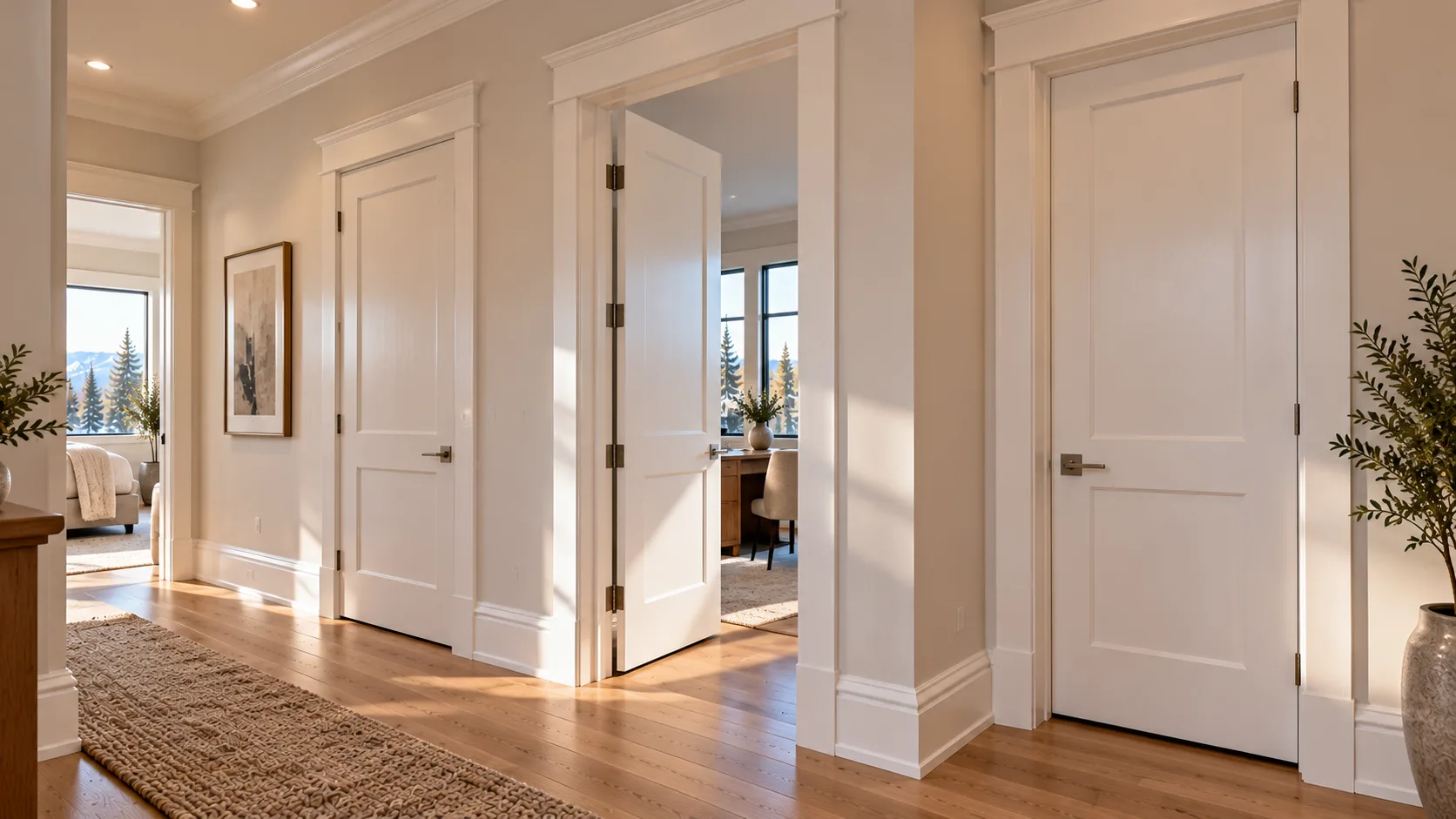
Slab or pre-hung
There are two ways to replace an interior door and the right choice depends on the condition of the existing jamb.
A slab replacement reuses the existing jamb and hardware locations. The new door is cut to size, mortised for hinges, bored for the handle set and hung. It is less disruptive, keeps the existing casing intact, and is the right call when the jamb is square, undamaged and the casing is staying.
A pre-hung door arrives already hung in a new jamb. The old jamb and casing come out, the new unit is set plumb and level in the rough opening, shimmed and fastened, then re-cased. It costs more and creates more work, but it is the only real option when the existing jamb is damaged, badly out of plumb, or when the casing is being upgraded anyway.
In practice, on a whole-house door replacement where trim is also being upgraded, pre-hung is usually the better value despite the higher unit cost — because the labour to make old jambs work well can exceed the saving.
Door types we install
- Hinged interior doors
- The standard swing door in solid-core or hollow-core. Solid-core costs more and is dramatically better for sound isolation — worth it for bedrooms, bathrooms and home offices.
- Barn doors
- Surface-mounted on a track. Useful where a swing door has nowhere to go. They do not seal, so they are poor for bathrooms and any room needing sound privacy. The track needs solid backing across its full span.
- Pocket doors
- Slide into a wall cavity, saving the full swing area. Excellent where space is tight, but installation requires opening the wall and the cavity cannot contain services or be a load-bearing element without engineering.
- Double and French doors
- Paired doors for a wide opening. Alignment between the two leaves is the demanding part.
- Bifold and closet doors
- Folding or sliding closet closures. Often the cheapest visible element in a house and one of the easiest to upgrade.
- Cased openings
- Removing a door entirely and finishing the opening with jamb and casing. Frequently the best answer for doorways that never get closed.
Get a free estimate for door installation
Tell us about the space for a free project estimate request. The contractor confirms scope and pricing; no obligation to proceed.
We review every estimate request. Any next step depends on confirming a suitable available contractor — there is no guaranteed callback or quote timeframe.
Why interior doors bind in Calgary homes
A door that closed cleanly in October and sticks in February is one of the most common calls we get, and it is almost never the door's fault. Two things drive it. Solid wood doors shrink and swell with humidity, and Calgary's indoor air routinely drops below 20% relative humidity in winter with forced-air heating — a swing wide enough to move a door several millimetres across its width. Separately, houses settle, and an opening that racks even slightly puts the door and the frame out of parallel.
The diagnosis is worth doing before anything is planed. If the binding is seasonal and moves around the door edge through the year, it is humidity, and the answer is usually adjusting the strike and hinges rather than removing material — wood taken off in February leaves a gap in July. If the binding is consistent and the gap around the door is visibly tapered, the opening has moved and the frame needs re-shimming or the door re-hung to match.
For new installations, the single biggest determinant of a door that works for decades is whether the frame is set plumb and square in an opening that is neither. Rough openings in Calgary homes are frequently out by several millimetres. Shimming a frame properly takes time, and it is the difference between a door that swings and stays where you leave it and one that drifts open or closed on its own.
Interior door types compared
| Type | Character | Considerations |
|---|---|---|
| Hollow-core moulded | Light, economical | Poor sound isolation; damages easily; the builder default |
| Solid-core moulded | Substantial feel, much better acoustically | The most common upgrade; heavier hinges required |
| Solid wood panel | Best appearance, takes stain | Moves most with humidity; needs a properly built finish |
| MDF panel (painted) | Very stable, crisp paint finish | Heavy; will not tolerate genuine wetting |
| Pocket / sliding | Saves floor area | Needs wall cavity; hardware quality determines whether it lasts |
| Barn-style sliding | Decorative, easy retrofit | No sound isolation, no latching; not for bathrooms |
What a proper door installation includes
- Checking the opening
- Plumb, level and square measured before anything is fitted. The numbers determine how the frame is shimmed.
- Shimming behind every hinge
- Solid bearing at each hinge point. Without it the frame flexes and the door drops over time.
- Consistent reveal
- An even gap around the door — typically 3mm at the sides and top. Inconsistency here is the most visible sign of a rushed hang.
- Correct hinge count for the weight
- Solid-core and solid wood doors need three hinges, and heavier doors need heavier hinges. Two hinges on a solid door will sag.
- Strike plate fitted to the actual latch position
- Marked from the closed door rather than measured nominally, so the latch engages without being forced.
- Casing scribed where the wall is not flat
- So the casing sits tight against the wall rather than showing a shadow gap along one edge.
Request a whole-home door package
For several rooms, label each opening on a simple plan and photograph both sides. Record whether you want to keep the existing jamb and casing or replace the complete pre-hung assembly. A proposal for slabs alone is not comparable to one including jambs, casing, hinges, handles, painting and disposal.
Mention finished-floor changes before ordering. A new threshold or different floor thickness can affect door clearance and reveal problems in an older opening. Ask the installer to confirm handing on site rather than relying on “left” and “right” in an email. For double doors and closets, show the adjacent furniture and swing space.
Garage-to-house doors, fire-rated assemblies and changes to an opening need separate assessment. Do not substitute a decorative interior door where another assembly is required. The contractor should confirm the applicable product and installation requirements before a quote is approved.
Calgary Carpentry prioritizes suitable larger projects; a single small repair may not match an available contractor. Include the total opening count and any related trim work in your request. Scope fit, availability and pricing are confirmed after review.
Answers
Frequently asked questions
Can I just replace the door slab and keep my existing frames?
Often yes, provided the existing jamb is square, sound and staying. The new slab is cut to fit, mortised for hinges and bored for hardware. If the jamb is damaged, badly out of plumb, or if you are upgrading the casing anyway, a pre-hung unit gives a better result.
How much do interior doors cost to install?
The main variables are whether you are fitting slabs or pre-hung units, the door specification — hollow-core, solid-core, panelled, glazed — and whether casing is being replaced at the same time. Slab replacement is less per door but is only viable with good existing jambs. We quote per opening after inspecting the frames.
Are barn doors a good idea?
They are excellent where a swing door has nowhere to go, and they look good. They are a poor choice for bathrooms and any room needing sound privacy, because they do not seal against a jamb. They also need solid backing across the full track span and clear wall for the door to slide onto.
Can you install a pocket door in an existing wall?
Yes, but it requires opening the wall to install the pocket frame, and the wall cavity must be free of electrical, plumbing and ductwork. It cannot be done in a load-bearing wall without proper structural provision. We assess what is inside the wall before committing, since services in the cavity are the most common reason a pocket door is not feasible.
My doors stick and will not latch. Can that be fixed without replacing them?
Usually. Sticking doors are typically a hinge, strike-plate or jamb alignment issue caused by seasonal movement or settlement, and adjustment or re-shimming resolves most cases. Occasionally the door itself has warped, which does require replacement. We will diagnose before recommending new doors.
Why does my door stick only in winter?
Almost always humidity rather than the door itself. Calgary indoor air in winter with forced-air heating routinely drops below 20% relative humidity, and wood responds by shrinking — then swelling again as humidity rises through spring. A door binding seasonally is moving with that cycle, and planing material off in February leaves a visible gap by July. The right fix is usually adjusting the hinges and the strike plate so the door works across the full range, and, if the swings are extreme, addressing the humidity itself.
Can I replace interior doors without replacing the frames?
Often yes, and it is considerably cheaper. It works where the existing frames are sound, square and the size you want to keep — the new door is fitted to the existing frame, with hinges mortised to match. Where it does not work is when frames have racked with settlement, when you are moving from hollow-core to solid-core and the existing frame or hinges will not carry the weight, or when you want a different opening size. We check the frames before quoting, because "slab only" and "door and frame" are very different numbers.
Are pocket doors a good idea in an existing home?
They save real floor area, which makes them attractive in tight spaces like ensuites and laundries. The two things to know are that the wall has to be able to take the cavity — which means it cannot be structural and cannot carry plumbing or significant electrical in that section — and that hardware quality determines everything about whether the door still runs smoothly in ten years. Cheap pocket hardware is the most common reason people dislike pocket doors. Retrofitting one into an existing wall means opening that wall up, so it is best combined with other work in the room rather than done alone.
Related services & guides
Trim Carpentry
The full finish carpentry service.
Learn moreWindow Trim
Matching casing profiles.
Learn moreBaseboards
Baseboard scale and casing thickness.
Learn moreInterior Door Buying Guide
Types, cores and hardware.
Learn moreDoor Installation Cost in Calgary
What to expect — from a simple slab swap to a new opening in a load-bearing wall.
Learn more
Why homeowners choose us
Careful work, honestly quoted.
A clear request and an agreed next step help you compare the right scope with an independent contractor.
Free project request
Tell us what you want to build without an obligation to proceed. A contractor confirms any estimate or visit arrangements.
Clear project scope
Measurements, photos and your priorities help a contractor discuss materials, installation and quote inclusions.
Your sharing choice
An enquiry is not an automatic handoff. Separate buyer consent and project acceptance are recorded before sharing details.
Contractor-led estimates
The contractor discusses requirements, site visits, pricing and the work. Availability and timing require confirmation.
Where we work
Calgary Carpentry serves Calgary and the surrounding communities.
Thinking about door installation?
Request a free carpentry project estimate. A contractor discusses the requirements and provides the estimate; site visits and timing require confirmation.
We review every estimate request. Any next step depends on confirming a suitable available contractor — there is no guaranteed callback or quote timeframe.