Service area
Custom Carpentry in Calgary
The short answer
We provide custom carpentry across all four Calgary quadrants and the surrounding towns — built-ins, cabinetry, trim, feature walls, basement carpentry and commercial millwork. Calgary’s housing stock spans 1950s bungalows, 1970s split-levels, 1980s and 1990s two-storeys, inner-city infills and post-2010 new builds, and each of those eras presents different carpentry conditions. Estimates and in-home consultations are free.
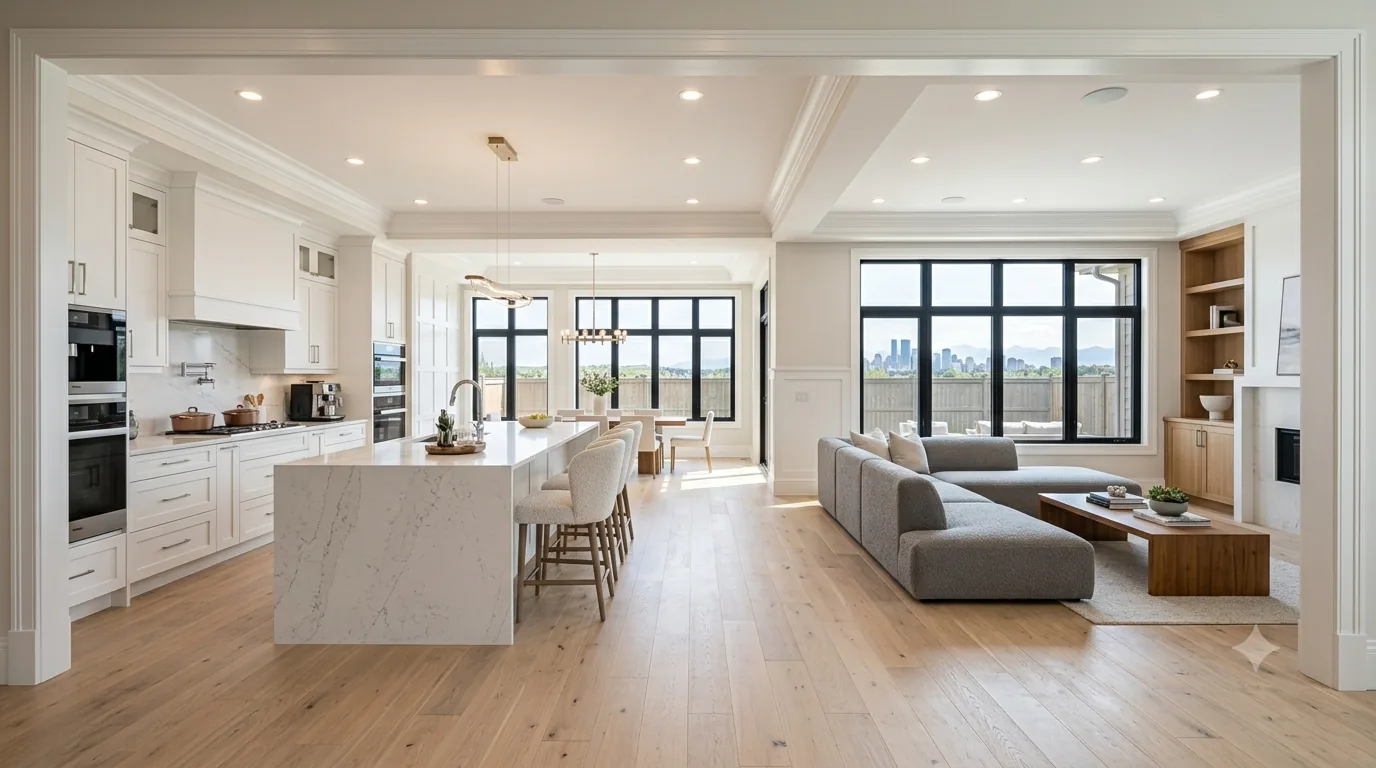
Calgary’s housing stock, and what it means for carpentry
Calgary is not one housing market, and it is not one carpentry problem. The city grew in distinct waves and each wave left behind a different set of construction conditions.
The inner-city communities built in the 1950s and 1960s — Killarney, Glendale, Altadore, Acadia, Charleswood — are dominated by bungalows with 8ft main-floor ceilings, plaster or early drywall, and original fir trim that has darkened with age. These houses have settled substantially, which means out-of-square openings and floors that are rarely level. Matching original trim profiles is a common request and a genuinely skilled job.
The 1970s and 1980s brought split-levels and two-storeys to Ranchlands, Dalhousie, Whitehorn, Marlborough, Pineridge and Woodbine. These are the houses where oak everything defines the era — oak trim, oak railings, oak kitchens. They are structurally sound and enormously improved by trim and cabinetry updates.
The 1990s and 2000s filled Edgemont, Hawkwood, Tuscany, Douglasdale, McKenzie Lake, Evergreen and Bridlewood with larger family homes, often with 9ft main floors and vaulted entries. Here the work tends to be built-ins, basement development and updating builder-grade finishes.
Post-2010 communities — Mahogany, Auburn Bay, Seton, Cranston, Evanston, Sage Hill, Redstone, Cornerstone, Livingston, Carrington — are new enough that the carpentry request is usually additive: a media wall, a mudroom, closet systems, a basement build-out.
And running through the middle of all of it, the infill market in Killarney, Marda Loop, Altadore, Bridgeland, Renfrew, Bowness and Montgomery is producing houses with 10ft main floors, open plans and a real appetite for millwork.
What we build across the city
- Built-ins and cabinetry
- Living-room shelving, media walls, window seats, bars, pantries, vanities and storage walls. The largest share of our residential work.
- Trim and finish carpentry
- Baseboards, casing, crown, wainscoting and door packages — whole-house or room by room.
- Storage and organisation
- Closet systems, walk-in dressing rooms, mudrooms and laundry cabinetry.
- Basement carpentry
- Built-ins, bars, media walls, under-stair development and trim within permitted basement developments.
- Feature and accent walls
- Fluted, slatted and panelled treatments from a single accent wall to a full-height architectural feature.
- Commercial millwork
- Reception desks, office casework, retail fixtures and hospitality millwork for Calgary businesses.
The one climate factor that affects every project
Calgary’s dry air is the single most important environmental factor in carpentry here, and it is the reason so much cabinetry and trim in the city develops the same faults.
Indoor relative humidity in a heated Calgary house routinely drops to 15–25% in deep winter, from perhaps 40% in summer. Wood responds by giving up moisture and shrinking across the grain. Mitres open, panel joints crack, wide boards cup, and solid-wood doors develop visible lines where a painted panel has shrunk away from its frame.
Chinooks make it worse by adding rapid cycling — a twenty-degree temperature swing in a day changes how hard the furnace runs and therefore how dry the house gets, repeatedly through the season.
None of this is unmanageable, but it does require deliberate choices: MDF rather than solid wood for painted components, floating panels that are free to move, engineered panel for wide flat surfaces, coped rather than mitred inside corners, and acclimatising material inside the house before it is cut and fitted. Homeowners help enormously by running a humidifier through winter and holding indoor humidity near 35%.
Get a free estimate in Calgary
Tell us about the space and request a free preliminary review — no cost, no obligation.
We review every estimate request. Any next step depends on confirming a suitable available contractor — there is no guaranteed callback or quote timeframe.
Common projects by house era
| Era | Typical Calgary communities | Most requested carpentry |
|---|---|---|
| 1950s–60s bungalows | Killarney, Glendale, Acadia, Charleswood, Bowness | Trim matching, built-ins, kitchen carpentry |
| 1970s–80s split-levels | Ranchlands, Whitehorn, Marlborough, Woodbine | Railing and stair updates, trim replacement, basement builds |
| 1990s–2000s two-storeys | Edgemont, Tuscany, Douglasdale, Evergreen | Built-ins, basement development, closet systems |
| Post-2010 new builds | Mahogany, Seton, Evanston, Redstone, Livingston | Media walls, mudrooms, feature walls, basement build-out |
| Inner-city infills | Marda Loop, Altadore, Bridgeland, Renfrew | Full-height millwork, feature walls, integrated storage |
How Calgary’s housing stock shapes carpentry work
Calgary is really several building eras stacked on top of each other, and the era decides almost everything about how a carpentry project runs. Inner-city communities like Hillhurst, Bridgeland, Renfrew and Altadore hold pre-war and mid-century homes with plaster walls, narrow openings and original trim profiles no supplier stocks today. Suburban communities built between 1980 and 2005 are conventional stick-framed houses with predictable geometry and builder-grade finishing that has aged worse than the structure. The newest communities on the edges — Livingston, Seton, Cornerstone — are large, open-plan and typically sold with generous volumes and minimal millwork.
Those three groups need different things. Older homes need matching: taking a section of an existing profile and having a knife ground so a repair or an extension disappears into the original. Suburban homes from the builder era usually want upgrading — taller baseboard, better casing, crown in the main rooms, and built-ins in the spaces the builder left blank. New builds want the millwork that was value-engineered out before handover, and they want it planned around ceilings that are often nine or ten feet rather than eight.
Infills are their own category. Calgary has an unusual concentration of two-storey infills on narrow inner-city lots, and they share a set of problems: tall narrow stairwells, open-plan main floors with very few walls to build against, and a lot of hard reflective surface. Millwork in an infill often has to do acoustic work as well as storage work, because the rooms are loud.
What we are asked for, by area
| Area | Typical housing | Most requested work |
|---|---|---|
| Inner city (NW/SW core) | Character homes, infills | Profile matching, stair work, acoustic millwork |
| Established suburbs | 1980–2005 builds | Trim upgrades, basement development, built-ins |
| New communities | Post-2015 builds | Feature walls, mudrooms, bonus rooms, pantry storage |
| Downtown / Beltline | Condos and lofts | Space-efficient built-ins, storage walls, murphy beds |
| Acreages (Bearspaw, Springbank) | Large custom homes | Timber work, libraries, large-format cabinetry |
Permits, and where Calgary differs from the surrounding towns
Within city limits, permits go through the City of Calgary rather than through a town office or Rocky View County. Interior finish carpentry — trim, built-ins, cabinetry installed against existing walls — does not normally need one. Basement development does, as does anything that moves a wall, changes egress or alters structure. Calgary also has its own development permit process that can apply where a project changes the building envelope, which matters more for additions than for interior work.
The requirement most likely to constrain a plan is egress. Any basement bedroom needs a compliant window with a minimum openable area and a maximum sill height, and in older Calgary homes that frequently means enlarging an existing opening — which means excavation, a window well, and a structural lintel. It is far cheaper to establish that at the design stage than after built-ins are drawn around a room that cannot legally be a bedroom.
Communities we serve in Calgary
If your community is not listed it is still worth asking — this is not an exhaustive list.
- Calgary
Answers
Frequently asked questions
Which areas of Calgary do you serve?
All four quadrants of the city plus the downtown core, and the surrounding communities of Airdrie, Chestermere, Cochrane, Okotoks, High River and Rocky View County. If you are outside that area it is worth asking — travel time affects scheduling more than feasibility.
Do you provide free estimates in Calgary?
Yes. In-home consultations and written estimates are free and carry no obligation. We measure, discuss what the space needs to do, and provide a fixed written quote rather than a rough range.
Can you match trim in an older Calgary home?
Usually. For the fir and oak profiles common in Calgary’s post-war and 1970s housing, matching means either sourcing a close stock profile or having a knife ground to reproduce the original. We take a physical sample of your existing trim and show you the options before committing.
Do you handle permits?
Carpentry alone rarely requires a permit. Permits become relevant for basement development, structural changes, and new electrical or plumbing work — all of which the City of Calgary administers. Where a project needs a permit we will tell you clearly and coordinate with the appropriate licensed trades or general contractor.
How far in advance should I book?
Lead times vary with season and shop loading, and demand is typically heaviest in autumn as people prepare for the holidays. Getting a consultation booked early costs nothing and secures a place in the schedule sooner.
Which parts of Calgary do you work in?
All four quadrants, downtown and the Beltline, and the surrounding communities — Airdrie, Chestermere, Cochrane, Okotoks, High River, Strathmore, Bearspaw, Springbank and Rocky View County. We have dedicated pages for each area with the housing stock and the local considerations that actually differ. Travel is built into the quote rather than added separately, and for the more distant communities we schedule in consolidated blocks so the disruption to your household is compressed rather than spread over weeks.
Do older Calgary homes cost more for carpentry work?
Often, and for reasons worth understanding before you compare quotes. Older homes have settled, so floors fall and openings go out of square, which means built-ins have to be scribed to the actual geometry rather than built square and pushed into place. Original trim profiles are not stocked and have to be matched with ground knives. Plaster behaves differently from drywall when you fasten into it. None of that is a problem — it is simply more hours than the same work in a 2010 build, and a quote that does not account for it is a quote that will change.
How far ahead should I book carpentry in Calgary?
Four to eight weeks from an approved quote to installation is typical, and most of that is fabrication rather than scheduling. Spring through early autumn is the busiest window across the whole trade, so book further ahead if you want work done then. Winter is usually easier to schedule and interior carpentry is unaffected by the weather. Small repairs and single-room projects can frequently be fitted in sooner.
Nearby areas & related services
NW Calgary
Tuscany, Edgemont, Varsity, Bowness and the northwest.
Learn moreSW Calgary
Marda Loop, Aspen Woods, Killarney and the southwest.
Learn moreSE Calgary
Mahogany, Cranston, Inglewood and the southeast.
Learn moreNE Calgary
Saddle Ridge, Redstone, Marlborough and the northeast.
Learn moreAll Services
The full range of carpentry work.
Learn more
Planning a project in Calgary?
Send a few details and we will look for an available contractor to review the project. Free, no obligation.
We review every estimate request. Any next step depends on confirming a suitable available contractor — there is no guaranteed callback or quote timeframe.