Trim & Finish Carpentry
Crown Moulding & Cornice Installation
The short answer
Crown moulding is trim installed at the junction of wall and ceiling, running at an angle to both. It suits rooms with 9ft ceilings or higher and can overwhelm a standard 8ft room unless the profile is kept modest. Installation is technically demanding because crown sits on a compound angle, ceilings are rarely flat, and every inside corner should be coped rather than mitred.
Calgary Carpentry is a project-intake and referral service. The following explains options to discuss with an independent contractor; specific methods, capabilities, availability and prices require that contractor’s confirmation.
Part of our Trim Carpentry service.
Where crown belongs — and where it does not
Crown moulding is not a universal upgrade. It works when a room has the height to carry it and an architectural language that suits it, and it looks forced when it does not.
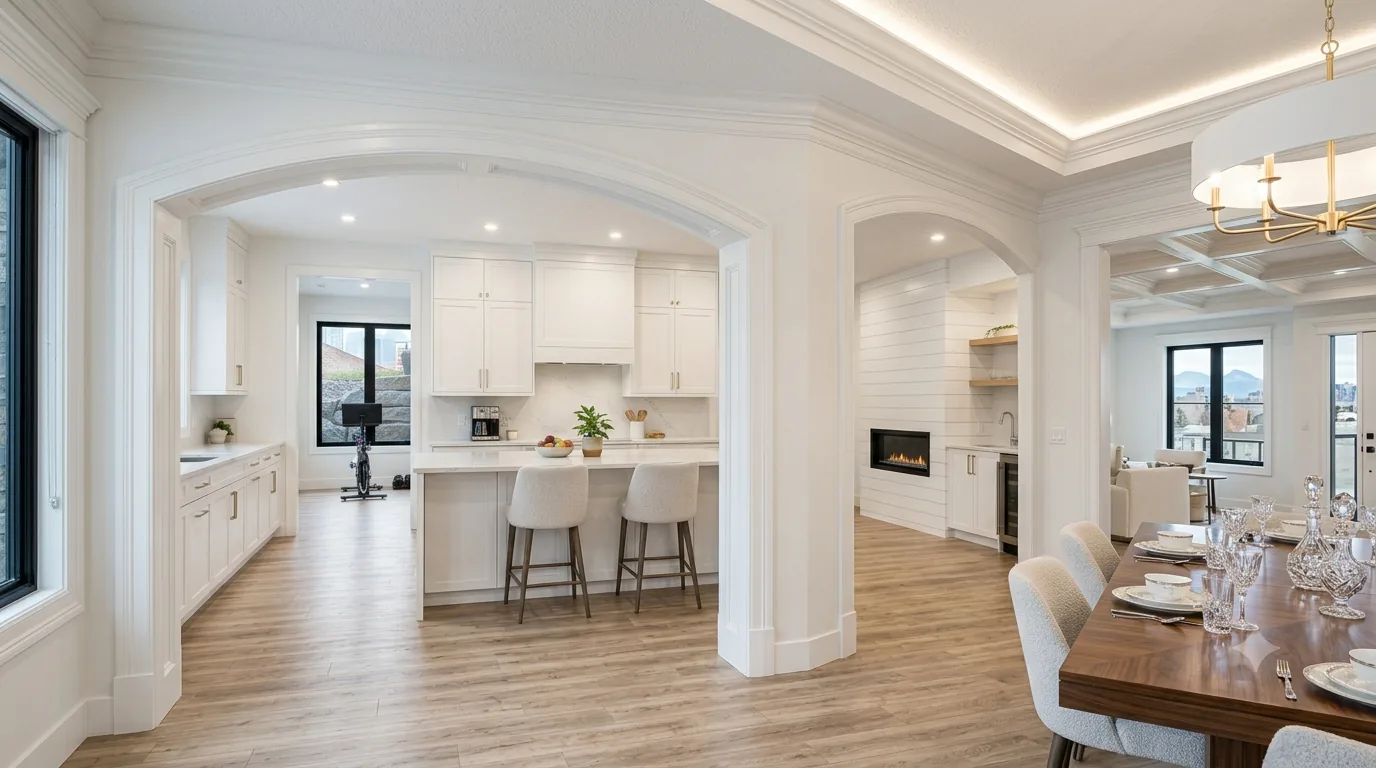
It belongs in principal rooms with 9ft ceilings or higher — living rooms, dining rooms, primary bedrooms, studies. It works well in traditional and transitional interiors and in the taller main floors of Calgary’s inner-city infills and estate homes.
It is usually wrong in rooms with 8ft ceilings unless the profile is very restrained, in most basements, in strictly minimalist interiors where the design intent is a clean ceiling junction, and in rooms with vaulted or sloped ceilings where the geometry becomes tortured. In those situations we will say so rather than take the work.
Crown styles
- Simple cove
- A concave single profile. Restrained, affordable, and the safest choice for 8ft ceilings.
- Traditional crown
- The classic profile with ogee and fillet detail. Suits 9ft ceilings and traditional interiors.
- Built-up cornice
- Two or three components combined to create a deeper, more substantial cornice. Appropriate in 10ft rooms and formal spaces.
- Square / stepped modern
- Rectilinear profiles with no curves. Suits contemporary interiors where a traditional ogee would look out of place.
- Crown with light cove
- A built-up assembly with a concealed channel for LED, washing light up the ceiling. Effective in rooms with height.
Get a free estimate for crown moulding
Tell us about the space for a free project estimate request. The contractor confirms scope and pricing; no obligation to proceed.
We review every estimate request. Any next step depends on confirming a suitable available contractor — there is no guaranteed callback or quote timeframe.
Choosing a profile for your ceiling height
| Ceiling height | Typical profile depth | Notes |
|---|---|---|
| 8 ft (standard) | 3½" – 4½" | Anything larger visually lowers the room. Most Calgary homes built before 2000 sit here. |
| 9 ft | 4½" – 6" | The most forgiving height. Almost any residential profile reads correctly. |
| 10 ft + | 6" – 8" | Small profiles disappear entirely. Often built up from two or three pieces rather than bought as one. |
| Vaulted / sloped | Varies | Requires compound angles that change along the run. Priced by complexity, not length. |
| Bulkheads and dropped soffits | 3" – 4" | Smaller than the main room profile so the bulkhead does not dominate. |
Why crown separates at the joints in Calgary homes
Almost every crown moulding callback in this city traces back to the same cause: indoor humidity swings much further here than the wood was ever conditioned for. Calgary winters combined with forced-air heating routinely pull interiors below 20% relative humidity, and a chinook can move outdoor conditions 25 degrees inside a day. Wood responds by shrinking across its width, and a mitred outside corner that was tight in September opens visibly by February.
The fix is not better caulk. It is coping the inside corners instead of mitring them, so that seasonal movement closes the joint rather than opening it, and gluing the outside mitres so the two pieces move as one. Where a run is longer than a single stick, a scarf joint cut at 45 degrees and glued keeps the seam from telegraphing. These are the details that separate trim that still looks right in five years from trim that needs re-caulking every spring.
Material choice matters too. MDF is dimensionally more stable than solid wood in a dry climate and takes paint beautifully, which is why most painted crown in Calgary is MDF. Solid wood is the right call for stained work and for bathrooms or basements where moisture is the bigger risk than dryness.
Mistakes we see most often
- Mitring inside corners
- Walls are never exactly 90 degrees, and a mitred inside corner opens as soon as the wood moves. Coped joints absorb both problems.
- Profile too large for the ceiling
- An 8-foot ceiling with a 6-inch crown feels lower, not grander. The moulding should read as a finish, not as a beam.
- Nailing only into drywall
- Crown has to be fastened into framing or into blocking installed for the purpose. Fixed to drywall alone, it pulls away at the top edge within a season.
- Ignoring the ceiling line
- Ceilings are rarely flat. Installing to a laser line without scribing to the actual surface leaves a visible wedge of shadow at one end of the run.
- Filling large gaps with caulk
- Caulk is for hairline joints. A 3mm gap filled with caulk cracks the first winter and looks worse than the gap did.
Answers
Frequently asked questions
Can I put crown moulding on 8ft ceilings?
Yes, but keep the profile small — a simple cove or a modest crown of around 75–100mm. Large built-up cornices in an 8ft room visually lower the ceiling and make the space feel compressed. In many 8ft rooms a taller baseboard is a better investment than crown.
Should crown moulding match my baseboard?
They should be compatible in style and proportion but they do not need to be the same profile. A common approach is a slightly smaller crown than baseboard in the same design language. What looks wrong is a heavily traditional crown with a flat modern baseboard, or vice versa.
Does crown moulding work with vaulted ceilings?
It is difficult and often not worth it. Where a sloped ceiling meets a flat wall the crown runs at a changing compound angle, and the transitions at the corners are awkward to resolve. Sometimes a flat trim board or simply no trim is the better answer. We will assess the specific geometry before recommending it.
How much does crown moulding cost?
It is priced by linear foot and depends heavily on the profile — a simple single-piece cove is much less than a three-part built-up cornice, which takes considerably more labour. Room complexity matters too: many corners, high ceilings requiring staging, and out-of-square walls all add time. We quote per room after measuring.
Can crown moulding be installed in a room with a bulkhead?
Yes, and it often helps — running crown around a bulkhead makes it read as an intentional architectural feature rather than a duct enclosure. The detailing at the corners takes care, but the result usually improves how the bulkhead looks considerably.
How long does crown moulding take to install?
For a typical Calgary living and dining area, one to two days for installation plus a day for filling, sanding and finish painting. Simple rectangular rooms go quickly. Time is driven by corners rather than by linear metres — a room with six corners and a bulkhead takes considerably longer than a larger plain rectangle. Vaulted or sloped ceilings need compound angles that change along the run and can double the time.
Can crown moulding be installed on a textured or stippled ceiling?
Yes, and it is common in Calgary homes from the 1970s through the 1990s. The moulding is scribed to follow the surface, and the small irregularities behind it are hidden by the profile. Where the texture is very heavy we sometimes knock back a narrow band along the ceiling line first so the moulding sits flat and the joint closes properly.
Related services & guides
Trim Carpentry
The full finish carpentry service.
Learn moreCoffered Ceilings
Grid ceilings and applied beams.
Learn moreBaseboards
Coordinating baseboard scale.
Learn moreTrim Selection Guide
Profiles and proportion.
Learn moreCrown Moulding Cost Calgary
What crown moulding costs in Calgary — materials, labour and the factors that move the num
Learn more
Why homeowners choose us
Careful work, honestly quoted.
A clear request and an agreed next step help you compare the right scope with an independent contractor.
Free project request
Tell us what you want to build without an obligation to proceed. A contractor confirms any estimate or visit arrangements.
Clear project scope
Measurements, photos and your priorities help a contractor discuss materials, installation and quote inclusions.
Your sharing choice
An enquiry is not an automatic handoff. Separate buyer consent and project acceptance are recorded before sharing details.
Contractor-led estimates
The contractor discusses requirements, site visits, pricing and the work. Availability and timing require confirmation.
Where we work
Calgary Carpentry serves Calgary and the surrounding communities.
Thinking about crown moulding?
Request a free carpentry project estimate. A contractor discusses the requirements and provides the estimate; site visits and timing require confirmation.
We review every estimate request. Any next step depends on confirming a suitable available contractor — there is no guaranteed callback or quote timeframe.