Built-ins & Cabinetry
Custom Floating Shelves
The short answer
A floating shelf is a shelf with no visible support, achieved by fixing a steel rod-and-plate bracket into wall structure and sliding a drilled solid-wood shelf over it. The engineering matters more than the wood: the bracket must land in studs or solid backing, and the shelf must be thick enough to house the rods without weakening. Properly built, a 1200mm hardwood floating shelf carries substantial weight indefinitely. Built with drywall anchors, it will sag or pull out.
Calgary Carpentry is a project-intake and referral service. The following explains options to discuss with an independent contractor; specific methods, capabilities, availability and prices require that contractor’s confirmation.
Request an estimate for floating shelves
Send the project location, a rough scope and any measurements you have. We will clarify the next step.
We review every estimate request. Any next step depends on confirming a suitable available contractor — there is no guaranteed callback or quote timeframe.
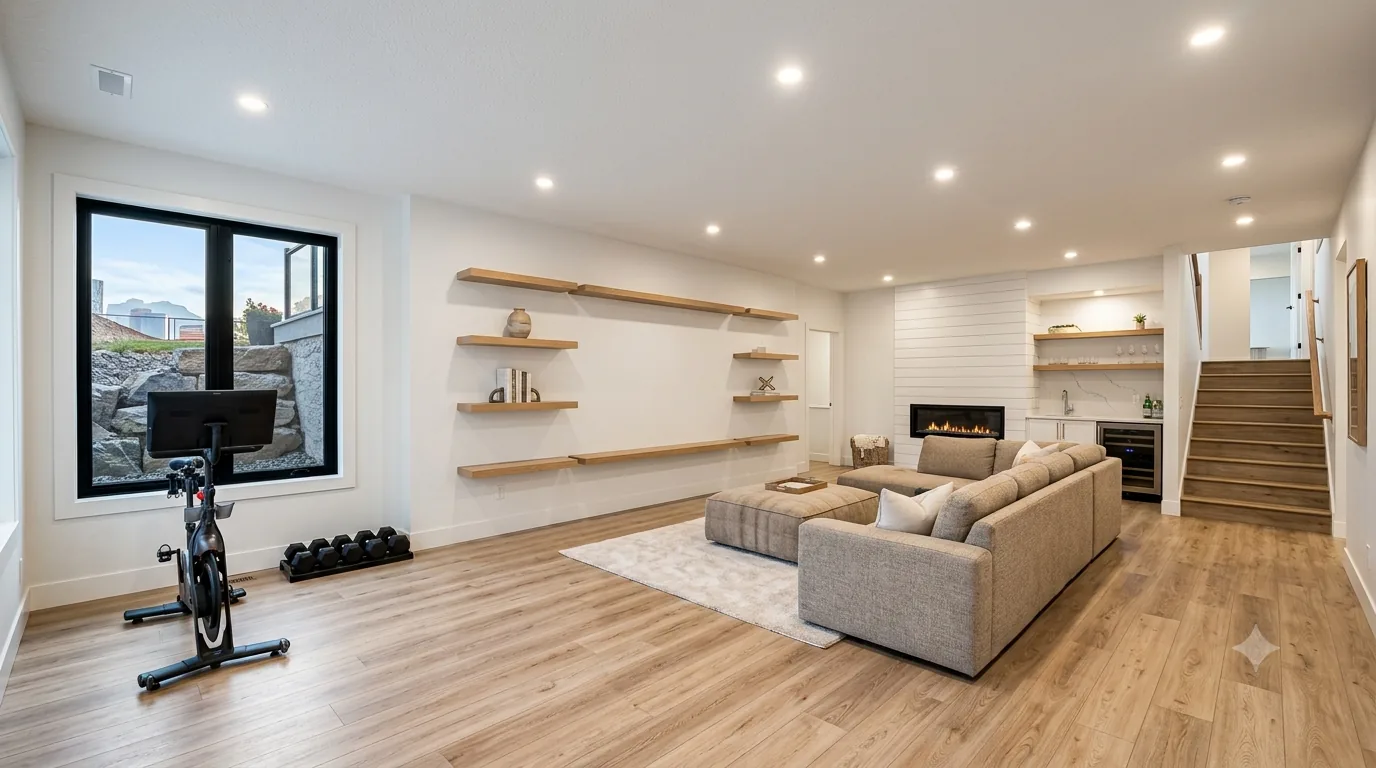
How a floating shelf actually works
The illusion is simple and the engineering is not. A steel plate is fastened flat to the wall, into studs or blocking. Horizontal rods project from that plate. The shelf has corresponding holes bored into its back edge, and it slides onto the rods until it meets the wall.
Everything that can go wrong follows from that description. If the plate is fastened to drywall alone, the fixing fails — it is a question of when, not whether. If the rods are too short relative to the shelf depth, the shelf droops at the front. If the holes are bored slightly off-axis, the shelf will not sit level and cannot be corrected afterwards. If the shelf is too thin for the rod diameter, it splits.
This is why floating shelves are a genuinely poor DIY project despite looking like the simplest possible carpentry. The hard part is invisible.
Shelf thickness, depth and span
Working guidance for solid hardwood shelves on concealed rod brackets. Longer spans are achievable with additional brackets landing in further studs.
| Shelf depth | Minimum thickness | Comfortable span between brackets |
|---|---|---|
| 150–200mm | 38mm | Up to 900mm |
| 250mm | 45mm | Up to 1200mm |
| 300mm | 50mm | Up to 1200mm |
| 350mm+ | 60mm+ | Up to 1200mm, additional bracket recommended |
Studs in most Calgary homes are at 400mm or 600mm centres, which sets where brackets can land. That spacing, not the wood, is usually the real constraint on a long shelf.
Get a free estimate for floating shelves
Tell us about the space for a free project estimate request. The contractor confirms scope and pricing; no obligation to proceed.
We review every estimate request. Any next step depends on confirming a suitable available contractor — there is no guaranteed callback or quote timeframe.
Where floating shelves work well — and where they do not
- Kitchens, in place of some uppers
- Opens the wall up and costs less than cabinetry. Best beside a window or flanking a hood, and best for items used daily so dust does not accumulate.
- Flanking a fireplace
- Two or three shelves either side of a chimney breast is one of the most requested applications, and one of the most effective.
- Bathrooms and powder rooms
- A single shelf above a toilet or beside a vanity. Specify a finish that tolerates humidity, and avoid species prone to movement.
- Entryways and hallways
- A shallow shelf as a landing surface. Depth matters — anything over 200mm in a narrow hallway becomes something people walk into.
- Not for heavy books over long spans
- A dense run of hardbacks over 1200mm is a serious load. A supported bookcase is the correct solution; floating shelves are the wrong tool.
- Not on unbacked drywall
- If there is no stud where the shelf must go, blocking has to be installed — which means opening the wall. We will tell you if that is the situation before quoting.
Wood choice and why it matters more here
A floating shelf is one of the few pieces of carpentry where the wood is fully exposed on every visible surface, so species and finish choices are unusually consequential.
White oak is the most requested and among the most suitable — hard, stable, straight-grained and takes a clear or light finish cleanly. Walnut is the premium choice for a feature shelf and looks exceptional against a pale wall. Maple is hard and pale with subtle grain, suiting a quieter room. Ash is a good-value hardwood with pronounced grain. Painted MDF shelves are a legitimate lower-cost option where the shelf should disappear into the wall rather than be a feature.
Calgary’s dry winters matter here. A thick solid slab will move seasonally, and a wide shelf can cup if it is finished on the show face only. Every face — including the underside and the ends — should be sealed equally so moisture exchange is even. It is an invisible detail that determines whether the shelf stays flat.
What we confirm before quoting a shelf
- Wall construction — stud-framed, concrete, or masonry each need a different fixing approach.
- Stud locations, which determine where brackets can land and therefore shelf length.
- Whether anything is buried in the wall at bracket height, particularly electrical.
- What the shelf will actually hold, so the bracket and thickness can be specified for the load.
- Whether lighting is wanted, since that must be designed in from the start.
- Species, finish and edge detail — square, eased or a slight bevel.
Answers
Frequently asked questions
How much weight can a floating shelf hold?
It depends entirely on the bracket, the fixing and the shelf, not on the wood alone. A properly specified steel rod bracket fixed into two studs, carrying a 45mm hardwood shelf, handles typical kitchen and display loads with a wide margin. We size the bracket to what you tell us the shelf will hold, so it is worth being honest about the heaviest realistic case.
Can floating shelves be installed on any wall?
Not on any wall without preparation. Stud-framed walls are straightforward when brackets can reach studs. Where no stud falls in the right place, blocking must be added, which means opening and repairing drywall. Concrete and masonry walls — common in Calgary basements — take mechanical anchors and are often stronger than a framed wall, but need the right fixing specification.
Will a solid wood shelf warp in Calgary’s dry climate?
It can if it is poorly prepared. Movement is minimised by using properly dried stock, by sealing every face equally including the underside and ends, and by allowing the wood to acclimatise indoors before final finishing. Shelves that cup almost always turn out to have been finished on the visible faces only.
How thick should a floating shelf be?
Thick enough to house the bracket rods safely and to look right for its length — see the table above. As a rule, 38mm for a shallow shelf, 45–50mm for typical kitchen and display shelves, more for deep or long shelves. Thin shelves over long spans look flimsy even when they are structurally adequate.
Can you make a live-edge shelf?
Yes. Live-edge slabs are stabilised, flattened and finished, then fitted to concealed brackets in the same way. The considerations are that the back edge must be straight enough to sit against the wall, and that a slab has more inherent movement than dimensioned stock — so acclimatisation and even sealing matter more, not less.
Do you install shelves you did not build?
Generally we prefer not to, because the bracket housing has to be bored to match the specific bracket and most supplied shelves are not machined for it. Where a shelf is suitable and correctly prepared we will look at it, but we cannot warrant the performance of a shelf we did not fabricate.
Related services & guides
Custom Built-ins
Full built-in shelving and cabinetry.
Learn moreKitchen Carpentry
Open shelving as part of a kitchen.
Learn moreFeature Walls
Wall treatments that shelving can sit within.
Learn moreFireplace Mantels
Shelving flanking a fireplace.
Learn moreWood Species Guide
Choosing a species for exposed work.
Learn morePaint vs Stain Guide
Finish choices and durability.
Learn moreBlog: Floating Shelf Installation
How floating shelves are properly installed.
Learn moreBlog: Shelf Weight Capacity
What concealed brackets can actually support.
Learn moreOpen Shelving in Kitchens
An honest look at whether it works in a real kitchen.
Learn moreChoosing Shelf Brackets for Built-In Shelving
The bracket choice that determines whether your shelves look designed or just placed.
Learn more
Why homeowners choose us
Careful work, honestly quoted.
A clear request and an agreed next step help you compare the right scope with an independent contractor.
Free project request
Tell us what you want to build without an obligation to proceed. A contractor confirms any estimate or visit arrangements.
Clear project scope
Measurements, photos and your priorities help a contractor discuss materials, installation and quote inclusions.
Your sharing choice
An enquiry is not an automatic handoff. Separate buyer consent and project acceptance are recorded before sharing details.
Contractor-led estimates
The contractor discusses requirements, site visits, pricing and the work. Availability and timing require confirmation.
Where we work
Calgary Carpentry serves Calgary and the surrounding communities.
Thinking about floating shelves?
Request a free carpentry project estimate. A contractor discusses the requirements and provides the estimate; site visits and timing require confirmation.
We review every estimate request. Any next step depends on confirming a suitable available contractor — there is no guaranteed callback or quote timeframe.