Comparisons
Kitchen Cabinet Refacing vs Replacement in Calgary
Updated 8 min read
The short answer
Reface when the cabinet boxes are sound and the kitchen layout works; consider replacement when boxes are damaged, storage is unsuitable or the layout needs to change. Refinishing is a separate option that retains the doors. Compare complete written scopes, including repairs, exposed panels, hardware, countertops and installation, rather than assuming a fixed percentage saving.
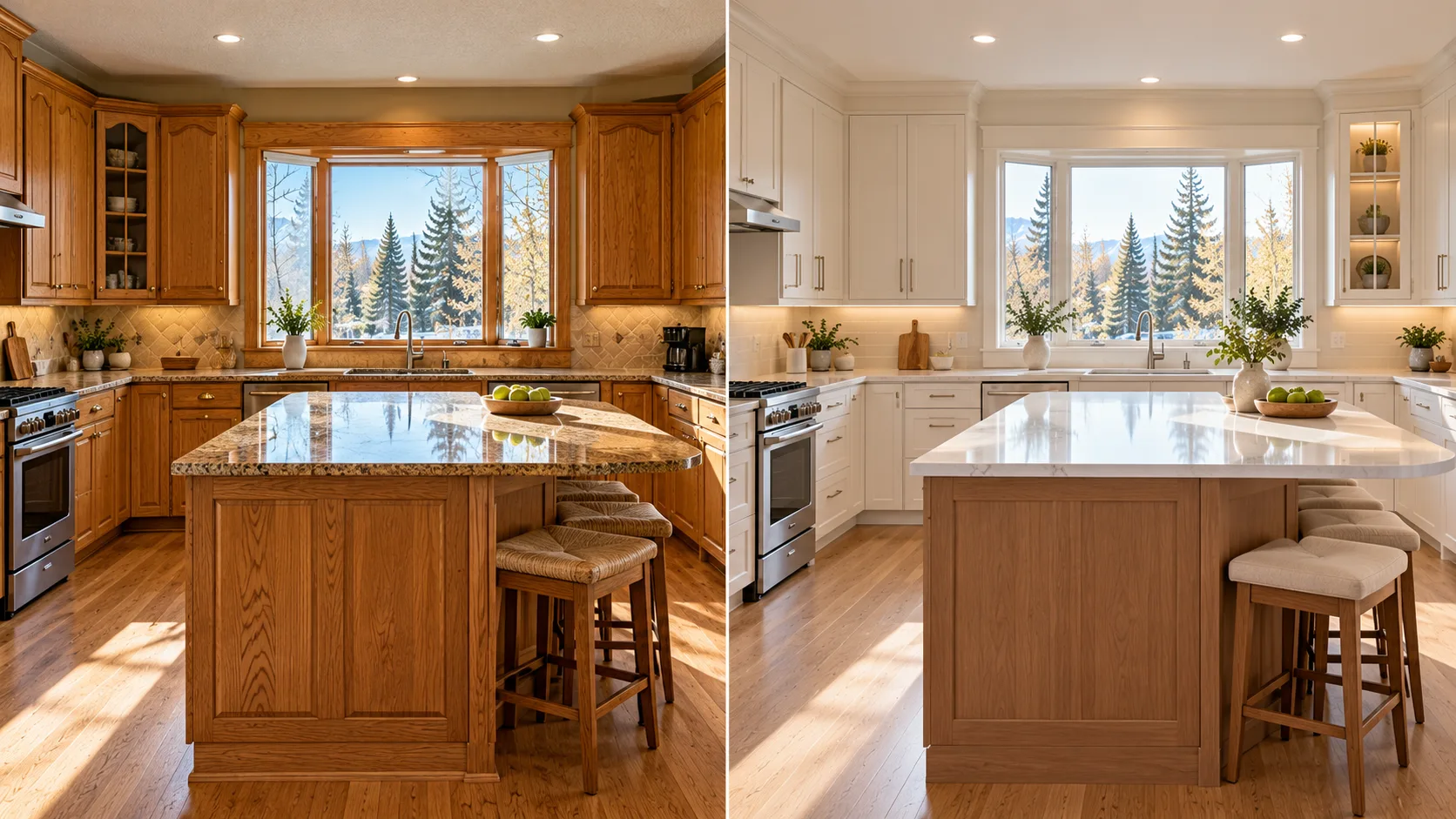
Refacing, refinishing and replacement are different jobs
Refinishing retains the existing doors and boxes and changes their surface finish. Refacing usually replaces doors and drawer fronts and covers or finishes the exposed cabinet-box surfaces to match. Replacement removes the boxes and starts with new cabinetry. A proposal that simply says “cabinet update” does not tell you which of those products you are buying.
Choose the method after inspecting the kitchen, not after choosing a colour. Refacing makes sense when the boxes are sound, the layout works and the existing storage can meet your needs with limited changes. Replacement deserves serious consideration when the boxes are damaged, the fixing points are unreliable or the layout creates daily problems.
The side-by-side illustration is an AI design comparison. It does not prove that the room on the right was created by refacing the room on the left. Images can help communicate a preferred appearance, but only an inspection and measured design can establish which existing parts can be reused.
Which approach fits the kitchen?
| Existing condition | First option to investigate | What still needs checking |
|---|---|---|
| Sound boxes, good layout, doors in good condition | Refinishing | Finish adhesion, preparation and realistic repair limits |
| Sound boxes and useful layout, dated or damaged doors | Refacing | Exposed ends, hinge positions and matching surfaces |
| Localized damage with otherwise useful cabinetry | Targeted repair plus refacing or refinishing | Cause of damage and the cost of a compatible repair |
| Swollen boxes or weak connections | Replacement assessment | Leaks, supporting surfaces and adjoining finishes |
| Poor layout or unsuitable storage | New layout and replacement comparison | Appliance locations, services and total renovation scope |
Inspect inside the cabinets before asking for a price
Empty the sink base and photograph the floor, back and connections. Check for staining, swelling, crumbling edges and loose joints. Inspect beneath the dishwasher area where accessible and look at the exposed ends beside appliances. New doors cannot repair a cabinet box that no longer holds fixings reliably.
Open drawers fully and test whether they travel smoothly. Record damaged runners, missing stops, sagging shelves and loose hinges. A reface quote may include new fronts but retain worn drawer boxes or runners. Ask which existing components are staying and which are being replaced.
Check upper-cabinet attachment and damaged backs with a qualified contractor where there is concern. Do not dismantle a loaded cabinet to investigate it yourself. If moisture damage is present, identify and address its cause before covering it with a new finish. Otherwise the cosmetic improvement can conceal a continuing problem.
Want this applied to your space?
Tell us about the space and upload photos for a free project review. An available contractor confirms scope, timing and pricing.
We review every estimate request. Any next step depends on confirming a suitable available contractor — there is no guaranteed callback or quote timeframe.
When a good-looking reface is still the wrong investment
You keep most of the old cabinet geometry when you reface. If the refrigerator blocks a doorway, drawers cannot open beside the oven or the sink area lacks usable working space, new doors will not solve those problems. Ask whether the layout genuinely suits your household for the next stage of ownership.
Inventory the storage before approving a reface. You may want deeper drawers, a different waste system or a taller appliance opening. Some alterations can be made to existing boxes; others turn a modest refresh into a complicated hybrid project. Price the combined scope against new cabinetry rather than assuming reuse always costs less.
Consider countertop plans at the same time. Keeping an existing countertop can be an advantage of refacing, but repairs and cabinet alterations may affect it. Replacement can involve removal damage, new templating and plumbing reconnection. Clarify who accepts responsibility for those interfaces and which outcomes cannot be guaranteed.
Compare costs using the same finished scope
180 Kitchens publishes a 2026 refacing estimate of CAD $5,000–$12,000 for an average kitchen across its Vancouver, Edmonton and Calgary markets. Reviewed October 23, 2026 at 180kitchens.com/should-you-reface-or-replace-cabinets-an-in-depth-analysis/. This is a contractor’s multi-market planning range, not a Calgary-only average or a Calgary Carpentry offer. Its applicability depends on kitchen size and specification.
Do not convert that range into a promised percentage saving. A small reface with simple fronts differs from one with repairs, new drawers, finished ends and decorative panels. Similarly, replacing boxes is not the same scope as a complete kitchen renovation. Compare two written proposals that include the same countertop, hardware, finish quality and necessary repairs.
For each option, add disposal, wall work, trade connections and tax if excluded. Identify allowances instead of treating them as final prices. If a selection is undecided, ask how changes are approved and priced. The useful number is the cost of a complete usable kitchen under the agreed scope, not the advertised starting price.
The details most likely to be missing
| Item | Ask the refacing bidder | Ask the replacement bidder |
|---|---|---|
| Exposed box surfaces | Which ends, fillers and face edges will match? | Which visible sides receive finished panels? |
| Drawers | Are boxes and runners retained or replaced? | What construction and hardware are included? |
| Hinges | Can existing boxes accept the proposed fixings? | What model and opening angle are specified? |
| Countertop | How will it be protected and supported? | Who removes, templates and reinstalls or replaces it? |
| Appliances | Are new model sizes compatible with the old openings? | Are panels and clearances based on selected models? |
| Completion | What preparation, adjustment and touch-up are included? | What installation and final adjustment are included? |
Select a finish that can be maintained
Ask to see the actual door material and edge construction. Painted MDF, timber, veneer, laminate and wrapped doors are different systems with different repair possibilities. A description such as “white shaker” only describes appearance. It does not explain the core, coatings, joints or care requirements.
Approve samples in the kitchen under both daylight and artificial light. The existing floor, countertop and wall colour can make a finish look warmer or cooler than it does in a showroom. Ask how old and new exposed surfaces will be matched; a sample door alone does not show the completed transition at a cabinet end.
Confirm cleaning instructions and how steam, heat and water should be managed. Discuss vulnerable edges beside the dishwasher, kettle and sink. Seasonal conditions in Calgary are a reason to follow the supplier’s care advice, not a reason to promise that one material never moves or fails.
Plan disruption and access realistically
Refacing often retains more of the kitchen than replacement, but there can still be sanding, adhesive work, door removal and installation activity. Ask which parts of the kitchen can be used, how surfaces are protected and what preparation you must complete. Do not assume every refresh is a one-day job.
For replacement, plan the order of demolition, cabinet installation, countertop measurement and trade reconnections. Ask what happens if a delivered item is damaged or a site condition changes the plan. A schedule should name dependencies and responsibilities rather than promise an exact duration without an approved design.
In a Calgary condo, include board approval, loading, elevator and work-hour rules in the enquiry. For an occupied detached home, explain whether access must be maintained for children, pets or mobility needs. Those practical constraints can affect installation sequencing and the suitability of different approaches.
A useful refacing-versus-replacement inspection checklist
- The existing layout supports cooking, cleaning and appliance-door movement.
- Cabinet boxes, backs and fixings are structurally serviceable.
- Any moisture problem has been diagnosed before surfaces are covered.
- Door, drawer, hinge and runner quantities are listed.
- Finished ends, fillers and visible edges are specified.
- Countertop protection, removal or replacement is assigned.
- Both proposals identify installation, disposal, repairs, trades and tax.
- Samples, warranty scope and change approval are in writing.
Questions to ask before paying a deposit
Ask for relevant completed work from the contractor, including close views of corners, cabinet ends and drawer alignment. A portfolio of new kitchens does not by itself show experience with the constraints of refacing old boxes. Ask how they assess unsuitable substrates and what happens if damage is discovered after removal.
Request a written description of warranty coverage for supplied materials and installation. Establish who handles hardware adjustments, finish defects and repairs to retained components. A warranty should explain the remedy and exclusions; its existence does not make old cabinet boxes new.
Confirm who you are contracting with, what is included in the accepted price and the payment milestones. Keep an approved drawing or scope schedule with the proposal. When comparing alternatives, write down the decisions you are buying: better access, a changed layout, repaired damage or a different appearance.
Take the next step with clear project details
Send wide kitchen photos, close-ups of damage, approximate dimensions and a short list of what currently frustrates you. State whether you want to retain the countertop and layout. Include your project location, budget band and timing so the enquiry can be assessed for fit.
Calgary Carpentry uses a free preliminary project review and manual contractor-routing workflow. Refacing service availability and suitability require confirmation; this comparison is not a claim that every contractor offers it. An available contractor determines whether the retained boxes can support the proposed work and provides any final quote.
Avoid a mixed-scope comparison
Consider a kitchen with useful cabinet boxes but worn doors and two troublesome drawers. A basic reface price might replace fronts and cover exposed ends while leaving those drawers untouched. A replacement quote might include new drawers throughout. Comparing the totals would tell you little until you add the drawer repairs to the reface option or remove equivalent upgrades from the replacement option.
The same issue arises with counters. One bidder may assume the old countertop stays; another may include a new surface and plumbing reconnection. Put the decisions in separate rows and ask each contractor which combination they can responsibly deliver. Do not assume a retained surface will survive removal or a new surface will hide an unsuitable cabinet base.
Once the scopes match, judge whether the extra work solves a real problem. If the existing layout already works, complete replacement may provide benefits you do not need. If the layout is frustrating every day, spending heavily to preserve it may be false economy. The inspection and your storage priorities should decide which option is worth pricing.
Keep a short list of non-negotiables, such as reliable drawers, space for the selected refrigerator and an easy-to-clean sink area. Use it to review both alternatives after samples and drawings are complete. A cosmetic refresh that misses those needs is not equivalent to a design that addresses them.
Answers
Frequently asked questions
Can swollen cabinet boxes be refaced?
A contractor needs to assess the extent and cause of damage. Covering a swollen or weak box does not restore its strength. Repair or replacement may be needed, and any active moisture problem should be addressed first.
Can I keep my countertops when replacing cabinets?
Sometimes, but removal, support and refitting create risks that depend on the countertop and layout. Ask the cabinet and countertop contractors to agree on responsibility before accepting the scope.
Is refacing always half the price of replacement?
No. Door count, substrate repairs, new drawers, hardware and exposed panels can narrow the difference. Compare complete current proposals for the same kitchen; published savings percentages are not quotes.
Does Calgary Carpentry provide refacing?
Calgary Carpentry collects project details for manual review and potential referral. Refacing fit and contractor availability must be confirmed before any service or price is promised.
Want this applied to your space?
Send a few details and we will look for an available contractor to review the project. Free, no obligation.
We review every estimate request. Any next step depends on confirming a suitable available contractor — there is no guaranteed callback or quote timeframe.